Start with the size of the bed, not the size of the bag
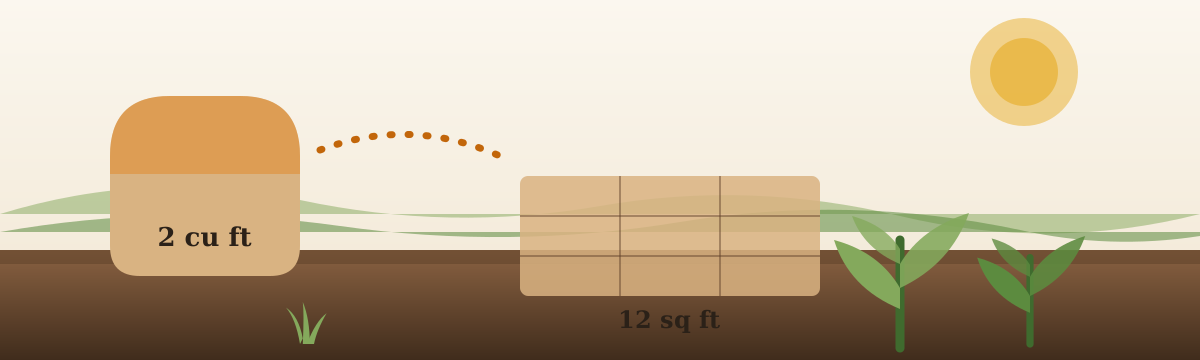
Every spring the same scene plays out in the garden centre aisle. The bed is twenty feet by ten feet, the bags on the pallet hold two cubic feet each, and nobody in the family knows how many should go in the cart. This calculator settles it in one step. You give the length and the width of the bed and the depth you want the mulch to sit at, and it returns the volume in cubic feet, the same volume in cubic yards if you are having a scoop dropped off, and the bag count at both 2 cu ft and 3 cu ft. Nothing rounds down, because running short two thirds of the way along a border is the expensive outcome, not the one spare bag left in the garage.
The three lines of arithmetic behind every answer
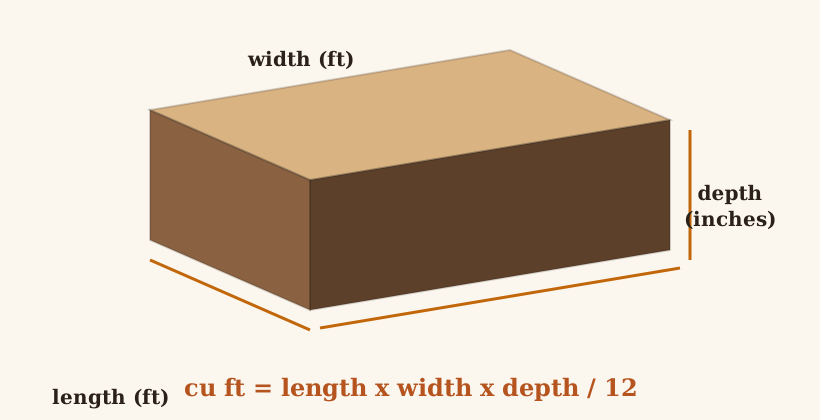
Mulch is a volume problem. The volume of a flat rectangular bed is length times width times depth, and the only awkward part is that beds are measured in feet while mulch depth is measured in inches. Those inches have to be divided by twelve before they can be multiplied by anything else.
- Cubic feet = length in feet × width in feet × depth in inches ÷ 12
- Cubic yards = cubic feet ÷ 27
- Bags of 2 cu ft = cubic feet ÷ 2, then rounded up to a whole bag
That is the entire system. Every number on this page is those three lines applied to a different bed, and they are written out in full so you can check them on the back of a receipt in the car park if you would rather not take the calculator's word for it.
Worked example: a 20 ft by 10 ft bed at 3 inches
Take the most ordinary bed there is, twenty feet long and ten feet wide, which is 200 square feet of planting space. At three inches deep the arithmetic is 20 × 10 × 3 ÷ 12 = 50 cubic feet. Divide 50 by 27 and you get 1.85 cubic yards, which is what goes on a bulk order or a delivery slip. Divide 50 by 2 instead and you get 25 bags of 2 cu ft mulch. If the pallet only carries the larger bags, 50 ÷ 3 = 16.67, so you buy 17 bags of 3 cu ft.
Those four figures are worth writing on your hand before you leave the house: 50 cubic feet, 1.85 cubic yards, 25 bags, or 17 big bags.
The same bed at 2 inches and at 4 inches
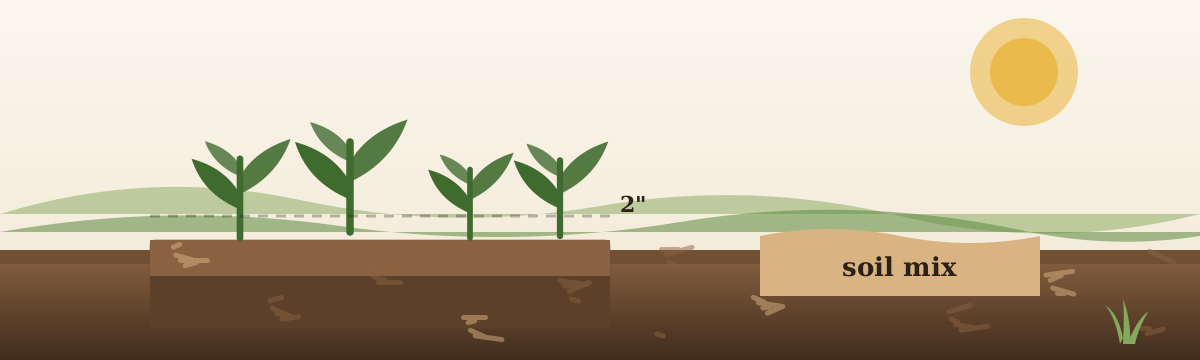
Depth multiplies straight through, which is why the argument about two inches versus three inches is really an argument about the budget. At two inches the same bed needs 20 × 10 × 2 ÷ 12 = 33.33 cubic feet, which is 1.23 cubic yards, which is 17 bags of 2 cu ft. At four inches it needs 66.67 cubic feet, 2.47 cubic yards, 34 bags. Two inches and four inches are not close: the deeper layer is twice the material, twice the bags, and twice the number of trips from the boot of the car to the back fence.
Cubic yards tell you what a truck carries. Bags tell you how many times you will bend down.
Small beds, patches and one-afternoon jobs
Not every job covers 200 square feet. A single 4 ft by 8 ft raised bed at two inches takes 4 × 8 × 2 ÷ 12 = 5.33 cubic feet, which is 0.20 cubic yards and 3 bags. Three bags is half an hour of work and one trip, and it is also the job most often postponed, because a bulk supplier wants a minimum order and three bags hardly feels worth starting the car for. It is worth starting the car for.
Round figures help with planning. A hundred square feet at four inches deep is 33.33 cubic feet, 1.23 cubic yards, 17 bags. A hundred square feet is about the foundation planting along the front of a small house, or two 4 ft by 12 ft vegetable beds standing side by side along a fence.
How far one cubic yard actually reaches
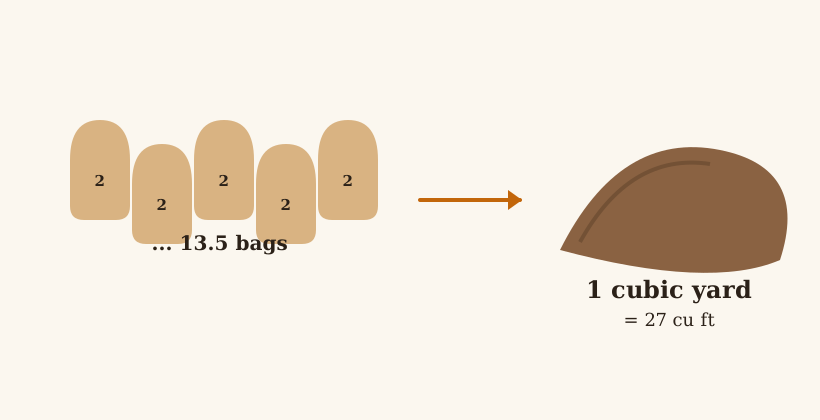
A cubic yard holds 27 cubic feet. Spread one inch deep, that yard covers 324 square feet, because 27 × 12 = 324. Spread three inches deep, the same yard covers 108 square feet. That single figure, 108 square feet per yard at three inches, is the fastest way to sanity-check a delivery: a 400 square foot bed wants roughly 3.7 cubic yards, and you can see without any calculator that four yards is the sensible order.
In retail terms, one cubic yard is 13.5 bags of 2 cu ft mulch, so a yard's worth bought by the bag means 14 bags. Buy the fourteenth. The half bag you never see is the half bag that would have finished the stripe along the edging.
Bags from the shop, or a scoop from the yard
Both are sold as volume, so the arithmetic above works either way; only the handling changes. Bulk material is priced by the cubic yard, arrives loose, and almost always carries a minimum quantity and a delivery charge, which is why it rarely makes sense below about one and a half cubic yards. Bagged material costs more per cubic foot but you can buy exactly what you need, in the colour and species you want, on a Saturday morning, and carry it home in whatever vehicle you already own.
- Choose bags when the total is under roughly a cubic yard, when the beds are small or scattered, when you want a specific bark or a cedar blend, or when a delivery truck cannot reach the beds without crossing a lawn.
- Choose bulk when the total passes a couple of cubic yards, when you have a place to tip a pile near the beds, and when one wheelbarrow day beats twenty-five trips up a garden path.
- Split the order when the front of the house is the only thing on show. Bulk for the back beds, bags for the border visitors actually walk past.
The mental arithmetic that sends people back to the shop
The classic mistake is deciding in advance that a bag covers a certain patch of ground, then dividing the bed by that number. It only works at one depth. A 2 cu ft bag covers 12 square feet at two inches, 8 square feet at three inches, and 6 square feet at four. Someone who fixes on twelve square feet and divides 200 by 12 buys 17 bags for a bed that needs 25, and discovers the shortage with a third of the border still bare and the shop about to close.
The other three repeat offenders are: subtracting the patio from the bed width but not from the length, measuring the bed once and reusing that figure for a bed of a different size on the other side of the path, and forgetting that mulch settles into the gaps of the previous layer instead of stacking neatly on top of it. Measuring twice costs a minute. A second trip costs an afternoon.
Adding up several beds in one order
Work in cubic feet and add at the end, because cubic feet is the only unit that stays honest across different depths. Say the plan is a 20 ft by 10 ft front bed at three inches, plus two 4 ft by 8 ft raised beds at two inches. The front bed is 50 cubic feet; each raised bed is 5.33 cubic feet, so the pair adds 10.67. The total is 60.67 cubic feet, which is about 2.25 cubic yards, or 31 bags of 2 cu ft once the last part bag is counted. Order to the total, not bed by bed, and the half-bags disappear.
For a curved border or a tree ring, break the shape into rectangles and triangles, or measure the widest point and the narrowest point, average them, and treat the result as a rectangle. A tree ring measured at the outside edge of the mulch, not at the trunk, is the measurement that matters.
One delivery a season beats four trips a month
Mulch is cheapest per cubic foot in quantity and cheapest per hour in a single session, so the practical rhythm for most gardens is one full top-up in spring and a small bag or two in autumn for anything that looks thin. Watch what the beds do over winter before deciding: a layer that sat at three inches in October usually reads closer to two by March, and the difference is what you are replacing. Bags left over from a part-used pallet keep perfectly well stacked flat under cover, so an over-order of two or three bags is storage, not waste.
Where these figures come from
- Clemson University HGIC 1604, Mulch — states that one cubic yard covers a 324 square foot area at one inch of mulch, and works the bed-area method from square footage, depth and the 324 divisor.
- University of Maryland Extension, Mulching Trees and Shrubs — recommended mulch depths by material and the clearance to keep between mulch and a trunk.
The conversion factors on this page (12 inches to the foot, 27 cubic feet to the cubic yard, 2 and 3 cubic feet for retail bags) are standard retail and extension practice. Bag sizes vary by brand, so check the figure printed on the bag before you trust a count.