What this page works out
Spacing advice on a seed packet is written for a row in a field, not for a four foot box behind a house. This page turns the number on the packet into a plant count for the bed you actually have, using the same arithmetic the calculator above runs: area in square inches divided by the square of the spacing, rounded down. The result is a single line naming the count and the spacing used, because that is the whole answer. No cost estimate, and no offset arrangement, since offset planting changes the count by enough to deserve its own explanation further down.
The formula, and why it rounds down
A spacing of 12 inches means each plant gets a square 12 inches on a side, which is 144 square inches. A bed of 32 square feet contains 32 x 144 = 4,608 square inches. Divide 4,608 by 144 and you get 32 plants. In one line: plants = floor(bed area in sq ft x 144 / spacing in inches squared).
The floor is not a rounding convention, it is a physical fact. At 18 inches, a 32 square foot bed gives 4,608 / 324 = 14.22. You cannot plant a fifth of a tomato, and forcing a fifteenth plant into a gap that is not there is how a bed ends up overcrowded by July. The calculator floors for the same reason. If you see a plant count quoted as 14.2, that page is showing you a division rather than a planting plan. Rounding up instead of down is the most common single reason a bed is too full before the season starts.
Example 1: 4 ft by 8 ft at 12 inches
Thirty-two square feet at 12 inch spacing. Each plant claims a foot square, so the bed is 4 plants across and 8 plants along, which is 32. The formula agrees: 4,608 / 144 = 32. This is the number for a bed of lettuce, chard, basil or storage onions, and it is the count most people overshoot. A seedling flat of 48 looks like it should fit and does not. Sixteen spare plants have to go somewhere, and the somewhere is usually the row you had planned for something else.
Example 2: 4 ft by 8 ft at 18 inches
Eighteen inches is a foot and a half, so a four foot width holds two plants with a foot left over. The formula works in area and does not care about that leftover strip: 4,608 / 324 = 14.22, floored to 14. In practice 14 is two rows of seven with a staggered edge, or an offset pattern that uses the leftover foot. That is the count for peppers, eggplant, compact determinate tomatoes or cabbage. It is emphatically not the count for carrots, where the same 32 square feet at 3 inches gives 512.
Example 3: 10 ft by 10 ft at 18 inches
A hundred square feet is 14,400 square inches. Divide by 324 and you get 44.44, which floors to 44. Notice what happened to the bed size: the area is 3.1 times the four by eight, but the count only rose from 14 to 44, about 3.14 times, because at a fixed spacing plant count is strictly proportional to area. That is the useful property of the formula. Double the bed and you double the plants at any spacing. The floor is the only thing that breaks the proportionality, and it breaks it by less than one plant.
Spacing to plant count at a glance
| Bed area | Spacing | Square inches per plant | Raw division | Plants (floored) |
|---|---|---|---|---|
| 32 sq ft | 6 in | 36 | 128.00 | 128 |
| 32 sq ft | 8 in | 64 | 72.00 | 72 |
| 32 sq ft | 12 in | 144 | 32.00 | 32 |
| 32 sq ft | 15 in | 225 | 20.48 | 20 |
| 32 sq ft | 18 in | 324 | 14.22 | 14 |
| 32 sq ft | 24 in | 576 | 8.00 | 8 |
| 32 sq ft | 30 in | 900 | 5.12 | 5 |
| 32 sq ft | 36 in | 1296 | 3.56 | 3 |
| 100 sq ft | 12 in | 144 | 100.00 | 100 |
| 100 sq ft | 18 in | 324 | 44.44 | 44 |
Read the last column against the raw division beside it. Every row where the two differ is a case where rounding up would have put more plants in the bed than the spacing allows.
Grid planting versus offset or triangular planting
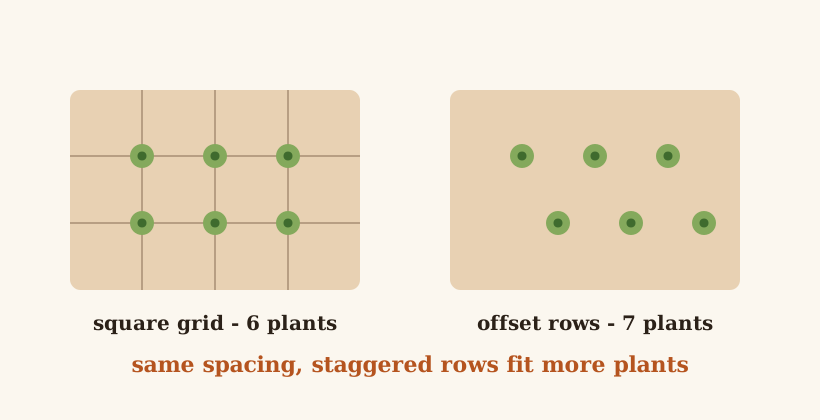
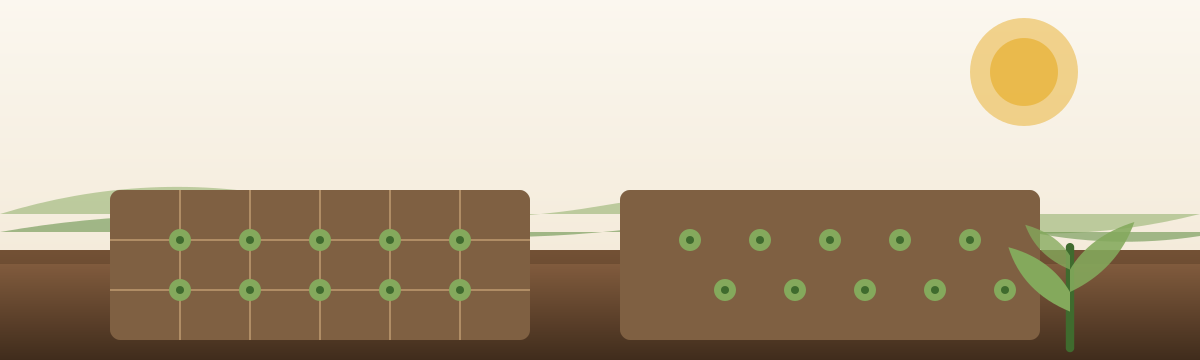
A grid puts every plant on the crossing point of evenly spaced lines: rows, columns, right angles, a checkerboard of bare soil between them. Offset planting shifts every second row by half a spacing, so each plant sits in the notch between two plants in the row ahead. At the same spacing that geometry fits roughly fifteen percent more plants into the same bed, because the distance between rows drops from one full spacing to about 0.866 of it, the height of an equilateral triangle, while the in-row distance stays the same. Every plant ends up equidistant from its neighbours, so none of them is shading a gap that could have held another plant.
Two practical notes. The fifteen percent is geometry, not a promise: it assumes a bed whose shape divides neatly and crops whose tops stay inside their allotted circle, which is untrue of a zucchini. And this calculator does not do offset planting at all, it prints one grid-based count. If you want the offset figure, take the grid count, add about fifteen percent, then floor it again, and expect to lose one or two plants at the bed edges where the pattern is cut off.
The packet number usually comes in two parts
Extension spacing charts list two numbers, between-row and in-row, written like 36 x 18. The second number is the one this calculator wants: the distance from one plant to the next inside a row, which is what decides how much room the roots and leaves get. The first number assumes open ground where you need a walkway or a tractor between rows, and in a raised bed you need neither, because you never step inside the frame. That is why a four foot bed can grow crops a chart spaces 36 inches apart. The chart is telling you how far apart rows must be to drive between them, not how far apart the plants must be.
Common vegetable spacings
| Crop | Typical in-row spacing | Plants in 32 sq ft |
|---|---|---|
| Tomato, indeterminate | 24-36 in | 8 at 24 in |
| Tomato, determinate | 18-24 in | 14 at 18 in |
| Pepper | 18 in | 14 |
| Eggplant | 18-24 in | 14 at 18 in |
| Cucumber, trellised | 12 in | 32 |
| Summer squash | 24-36 in | 8 at 24 in |
| Bush beans | 4-6 in | 128 at 6 in |
| Pole beans | 6-8 in | 72 at 8 in |
| Lettuce, leaf | 8-10 in | 72 at 8 in |
| Lettuce, head | 12 in | 32 |
| Kale and chard | 12-18 in | 32 at 12 in |
| Basil | 12 in | 32 |
| Carrot | 2-3 in | 512 at 3 in |
| Radish | 2 in | 1152 at 2 in |
| Onion sets | 4-6 in | 128 at 6 in |
 Tomato18-36 in
 Pepper18 in
 Cucumber12 in trellised
 Summer squash24-36 in
 Beans4-8 in
 Lettuce8-12 in
 Kale and chard12-18 in
 Basil12 in
 Carrot2-3 in
 Radish2 in
 Onion sets4-6 in
Typical in-row spacing. The table above carries the variety-by-variety detail; your seed packet wins every time.
These are the common worked figures, and they vary by variety, climate and how big you intend to let things grow. Treat the seed packet in your hand as the final word, then use the formula here to convert its spacing into a count for your bed.
Square foot gardening: the one foot grid
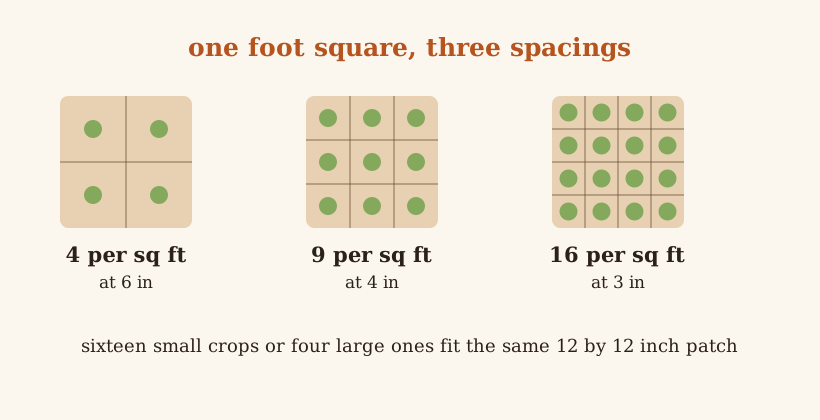
The square foot method reaches the same numbers by a different route. Divide the bed into one foot squares and plant a fixed count per square, derived from the spacing: at 3 inches a square holds 16 plants, four across and four down; at 4 inches, 9; at 6 inches, 4; at 12 inches, 1. Those counts are just floor(144 divided by spacing squared), so the method and the formula agree by construction rather than by coincidence. The grid is genuinely useful for small seeds and mixed beds, because you can put a square of carrots next to a square of basil and never lose track of what is where. What it cannot do is account for a tomato that spreads four feet wide inside a square foot of allocated space. A plant that outgrows its square needs a bigger square, not a cleverer pattern.
Row planting: how far apart the rows go
If you are planting rows rather than a grid, the number you need is row spacing, and in a raised bed it is set by the plants rather than by a chart. A row of bush beans needs just enough gap that the leaves of adjacent rows touch at maturity and no more. A row of trellised cucumbers needs the width of the trellis plus a foot for airflow. Take the mature spread of the crop, halve it, and that is the minimum gap from one row's centre to the next. Paths are the other half of the sum, and a four foot bed needs no internal path at all, which is exactly why that width is standard: it converts what would be path in a field into growing space in a box.
Should you sow extra for backup?
Yes for direct-sown seed, and the amount depends on germination rather than on the plant count. A packet at 85 percent germination needs roughly one extra seed in six to finish with the plants you planned, and older seed needs more. The cheap method is to sow about one and a half times the target count in the row, then thin to final spacing once seedlings are two inches tall. Thinning is not waste, it is how you avoid a row of gaps. For transplants, one spare in ten is plenty, and it is worth raising the spares in a corner of the same bed rather than a separate tray, because a spare that lived in the same soil and light as the crop transplants far better.
The count is a ceiling, not a target
The formula gives the maximum number of plants that fit at a given spacing. Whether that maximum is wise depends on things it cannot see: airflow in a humid summer, disease pressure, whether the variety is a compact one bred for containers or a sprawling heirloom, and whether you harvest all at once or pick over months. In a wet climate, planting at the calculated maximum is the fastest route to mildew on the lower leaves, and leaving out one plant in a row buys airflow for free. A bed also does not have to be full on day one. Quick crops such as radish and leaf lettuce can occupy the gaps between slow ones and be gone before the slow crop needs the room. For the between-row and in-row figures behind these counts, Clemson Cooperative Extension's garden planning factsheet publishes a full chart of vegetable spacings and planting dates.