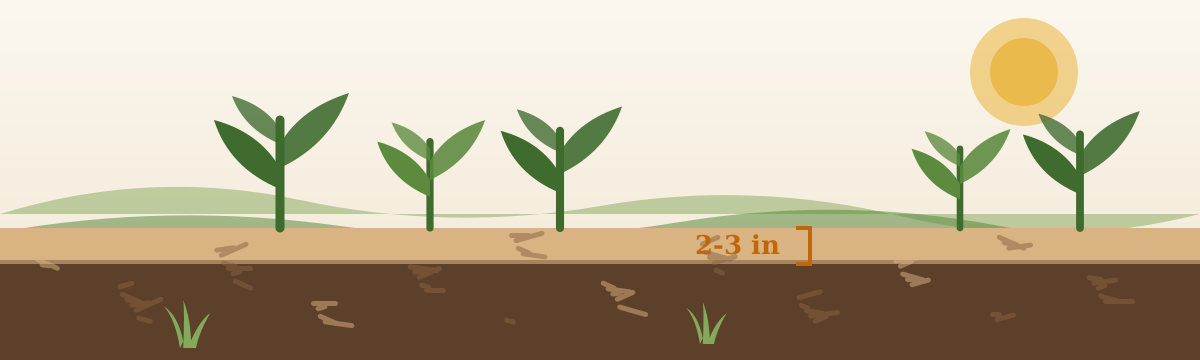
Depth is the only decision that changes the answer
Ask five gardeners how deep mulch should be and you will get three numbers, because depth is doing four jobs at once. It shades the soil surface so weed seed gets no light. It slows evaporation, which matters more than any fertiliser decision in a dry summer. It buffers soil temperature, keeping roots cooler in August and warmer through a hard frost. And it keeps rain from hammering bare soil into a crust, so water soaks in instead of running off toward the path. Two inches does the first three jobs reasonably. Three inches does all four well. Four inches is where you start paying for material you cannot use, unless the situation calls for it.
Depth by planting situation
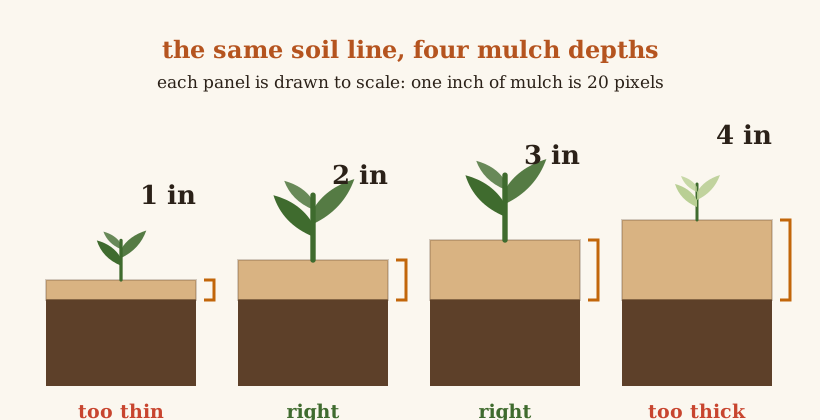
The honest answer is that depth follows what is growing, not what the bag says. A vegetable bed is worked, replanted and watered constantly; a shrub border is left alone for years. That difference decides the number.
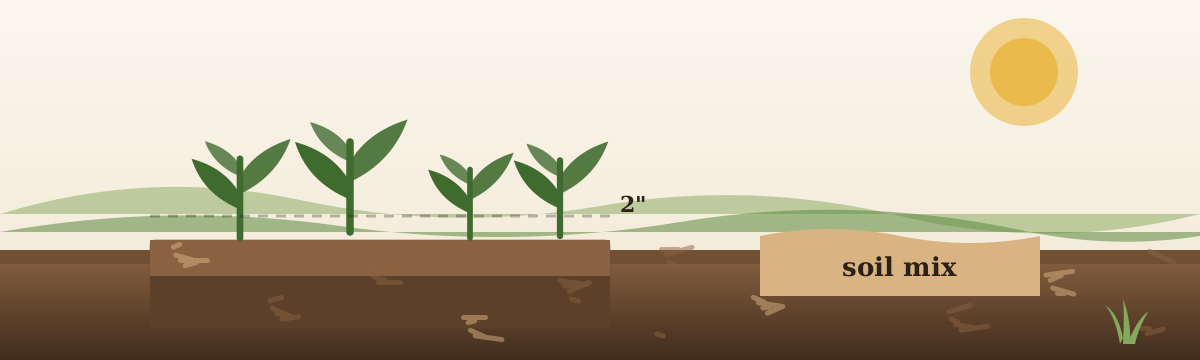
- Vegetable beds and raised beds: 2 to 3 inches. Deep enough to keep the soil surface moist between waterings, shallow enough that you can pull it back with two fingers when you are direct sowing or setting out transplants.
- Flower beds and mixed borders: 2 to 3 inches. Annuals get planted through it every year, so anything thicker becomes a weekly annoyance at planting time.
- Trees and shrubs: 2 to 4 inches, with a clear 2 to 3 inch gap between the mulch and the trunk. Coarse bark can go on thicker than fine material, because air moves through it.
- Paths and utility strips: 3 to 4 inches. Nobody plants through it and nobody digs in it, so a deeper layer lasts longer and suppresses weeds more completely.
- Newly planted perennials and shrubs: 1 to 2 inches for the first season. Shallow is safer while roots are still establishing in the top few inches of soil.
Bags and cubic yards per 100 square feet, at every depth
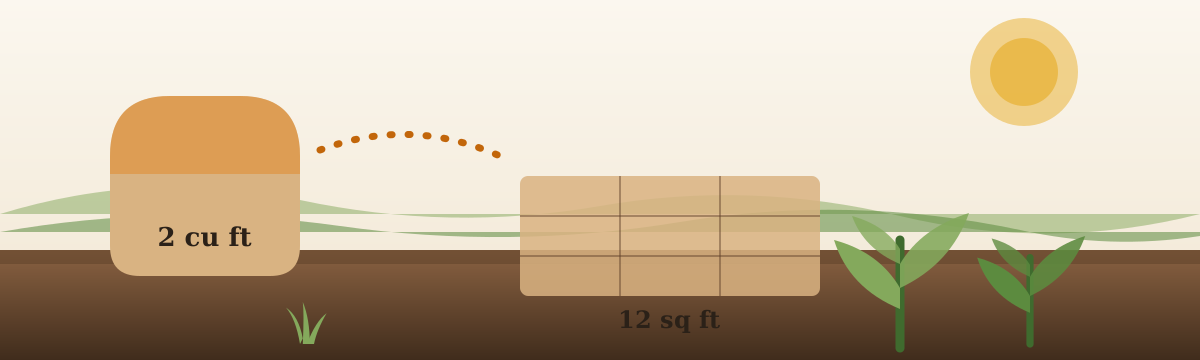
This table is the reference most gardens actually need, because a hundred square feet is a believable unit: a small front border, one long bed along a fence, or half a dozen rose bushes. Bag counts are for 2 cu ft bags and are rounded up.
| Depth | Cubic feet per 100 sq ft | Cubic yards | 2 cu ft bags |
|---|---|---|---|
| 1 inch | 8.33 | 0.31 | 5 |
| 2 inches | 16.67 | 0.62 | 9 |
| 3 inches | 25 | 0.93 | 13 |
| 4 inches | 33.33 | 1.23 | 17 |
Read down the last column and the cost of the decision becomes visible. Going from one inch to three inches on the same hundred square feet takes you from 5 bags to 13. Going to four inches takes 17. If the beds total 300 square feet and you settle on three inches, the answer is 39 bags, or 2.8 cubic yards if you would rather have it tipped on the drive.
What happens when the layer is too thin
An inch of mulch is decorative, not functional. Sunlight reaches the soil through the gaps as the material settles, so annual weed seed germinates straight through it, and the seedlings root into the mulch rather than the soil, which makes them easy to pull but constant work. Moisture loss is only marginally slower than on bare ground, so you water as often as before and wonder what the mulch was for. The layer also breaks down faster in relative terms, because a thin layer is mostly surface, and surface is where the weather does its work.
Thin mulch fails quietly. Nothing looks wrong in April; by July the bed is weedy, the soil is crusted, and the money spent feels wasted. If you are topping up an existing layer, measure what is already there before deciding the new depth, because one inch of fresh material over one inch of old is two inches total, which is a different job from three.
What happens when the layer is too thick
Four inches of fine bark over a perennial crown is not generous, it is a smothering. Roots need oxygen, and a deep, tightly packed layer slows gas exchange at the soil surface, so roots grow upward into the mulch where air is available and then dry out the first hot week nobody waters. The layer also holds water like a sponge above the soil, so light rain never reaches the root zone at all, and the soil underneath can stay dry while the surface looks soaked.
The second failure is structural. Thick mulch mats into a water-repellent sheet, sheds rain, and then compacts into an airless crust that is hard to rewet. The third failure happens at the base of trees, where a deep cone of mulch against the trunk keeps the bark continuously damp. That is the volcano look you see in car parks, and it invites rot and rodent damage at exactly the point where the tree cannot afford either.
The gap around a trunk is not optional
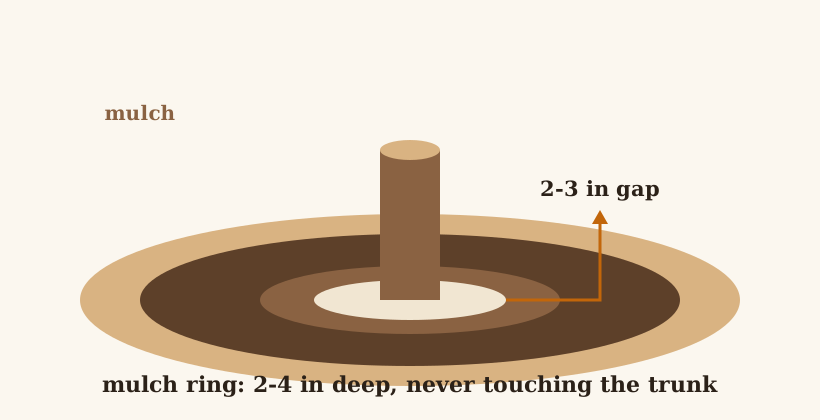
Keep mulch 2 to 3 inches back from the trunk of any tree or shrub and let the root flare show. The flare is where the trunk widens into the roots, and burying it is the single most common way a well-intentioned mulch ring damages a tree. A donut, thick at the outer edge and thin or empty in the middle, does the same weed suppression as a cone and none of the harm. Extension guidance on this point is consistent and unusually blunt, which tells you how often it is ignored.
When in the season to top up
Spring is the practical window for most gardens: the soil has warmed, the beds are being tidied anyway, and a fresh layer carries the planting through the dry months. Wait until the ground has warmed properly, because mulch applied over cold, wet soil slows the warming that root growth depends on. Autumn is the second window and the better one for weed suppression, since it puts a clean layer down before winter annuals get their start.
Whatever the season, measure the old layer first. Push a finger or a marked stick into the mulch in several places and note the depth. If it still reads two inches, you need one inch, not three, and that difference is more than half the order. Skipping the measurement is the reason some beds end up six inches deep after three well-meant springs.
Does the old mulch have to come out first?
Rarely. Old mulch is breaking down into organic matter, which is what you wanted it to do, and it is feeding the soil life under the surface. The exception is a layer that has gone bad: matted and water-repellent, sour-smelling underneath, or full of perennial weed roots that will simply grow up through anything you put on top. In those cases rake off the worst of it, loosen the surface with a fork, and start again at two to three inches.
What you should not do is add a fresh three inches every year without looking. Organic mulch does not vanish quickly, and the layers accumulate. Gardens that have been mulched annually for a decade often have eight inches of half-decayed material sitting over the crowns of plants that were supposed to be six inches tall.
Depth and the calculator on this page
The calculator above takes one depth at a time, so if you are weighing two inches against three, run it twice and compare the bag counts. The table further up the page already gives you every combination for a hundred square feet, which is usually enough to make the decision without another trip to the tool. Depth is a straight multiplier: double the inches and you double the cubic feet, the cubic yards and the bags.
Six common mulches, and the one that is applied differently
Almost every bag on a garden centre pallet is one of six materials, and the depth rule on this page is written for all of them: two to three inches on a bed, two to four around a tree. The exception is compost. Compost is a feed rather than a cover, so it goes on thin, roughly a quarter to half an inch, and it is usually topped with something else if you want the weed suppression a real mulch gives you. Everything else in the list below is judged by the same tape measure.
 Barkchunky, breaks down slowly
 Wood chipscheapest by the scoop
 Strawlight, good on beds and paths
 Compostapply thin, it is a feed
 Leaf mouldfree, gone in a season or two
 Pine needlesknits together, stays put on slopes
Depth is a property of the bed, not of the bag. A bark chip and a pine needle are different shapes, but three inches of either is three inches of cover, and the bag count on the calculator is the same. What changes between them is how long they last and how well they stay where you put them, which is a decision about money and slope rather than about arithmetic.
Where these figures come from
- Clemson University HGIC 1604, Mulch — depth recommendations by mulch texture and the problems caused by layers that are too deep, including reduced oxygen at the root zone.
- University of Maryland Extension, Mulching Trees and Shrubs — recommended depth for tree and shrub mulch and the clearance to leave between mulch and the base of the trunk.
- The Morton Arboretum, Mulching Trees and Shrubs — 2 to 4 inches for medium to coarse material, applied in a ring that avoids the trunk.
The table converts depth to volume with the standard 1 inch ÷ 12 method and 27 cubic feet to the cubic yard. Bag counts assume 2 cu ft bags, rounded up.