One bag, one number, and why it keeps changing
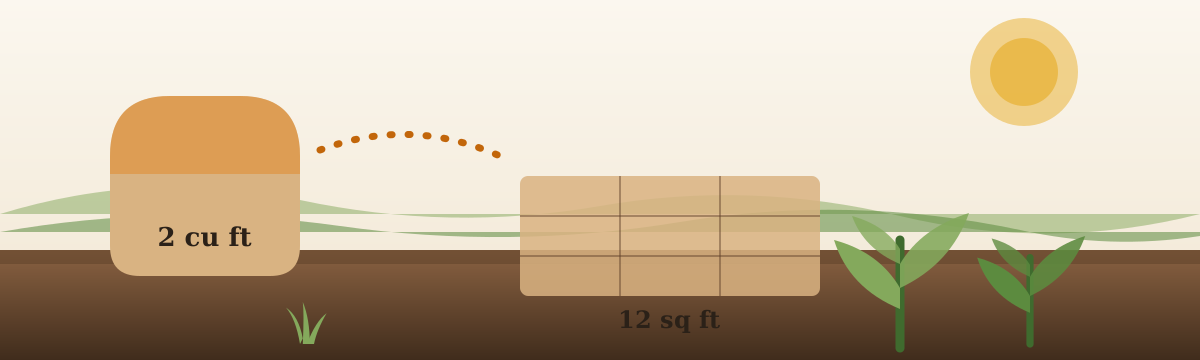
A bag of mulch holds a fixed volume. How much bed it covers is not fixed at all, because the same volume spread thinner goes further and spread thicker goes less far. That is the whole idea behind this page: a 2 cu ft bag covers 12 square feet at two inches, 8 square feet at three inches and 6 square feet at four, and every question about buying bags is a version of that sentence. Get the depth you want fixed first, and the coverage figure follows from it.
The coverage formula, in one line
Square feet covered = cubic feet of mulch ÷ (depth in inches ÷ 12). A 2 cu ft bag at 3 inches is 2 ÷ 0.25 = 8 square feet. Turning it around to plan an order, bags needed = area × depth ÷ 12 ÷ bag volume, rounded up. Both directions are the same arithmetic, and both are worth doing once on paper so that the numbers on a bag's label stop looking arbitrary.
Coverage for every bag size at every depth
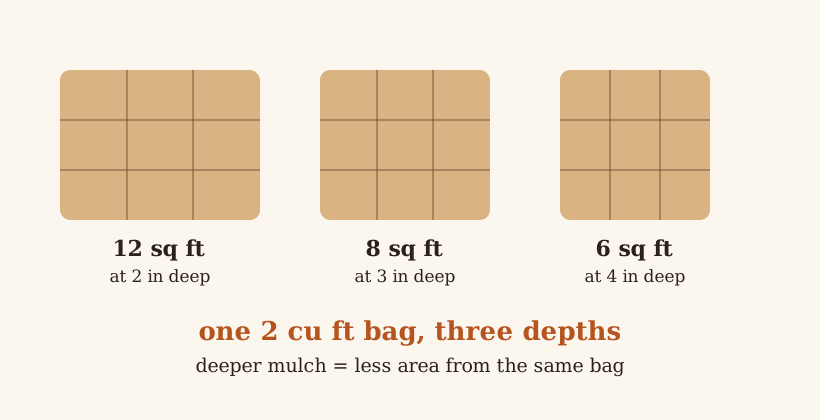
Bag sizes are not standardised, so the shelf will hold 1.5, 2 and 3 cubic foot bags, sometimes side by side and often at prices that make the comparison deliberately confusing. This table shows square feet covered per bag. Read across a row to see what a thinner layer buys you; read down a column to compare bag sizes at the depth you actually want.
| Bag size | 1 inch deep | 2 inches deep | 3 inches deep | 4 inches deep |
|---|---|---|---|---|
| 1.5 cu ft bag | 18 sq ft | 9 sq ft | 6 sq ft | 4.5 sq ft |
| 2 cu ft bag | 24 sq ft | 12 sq ft | 8 sq ft | 6 sq ft |
| 3 cu ft bag | 36 sq ft | 18 sq ft | 12 sq ft | 9 sq ft |
The pattern is easy to remember once you have seen it: doubling the depth halves the coverage, and a 3 cu ft bag covers exactly half again as much as a 2 cu ft bag at any depth. A 1.5 cu ft bag covers three quarters as much. Nothing here depends on the species of bark or the brand on the pallet, only on volume and depth.
Bags per 100 square feet
The most useful conversion for planning is bags per hundred square feet, because that is roughly one decent border. At two inches it takes 9 bags of 2 cu ft mulch. At three inches it takes 13 bags. At four inches it takes 17 bags. If you are pricing a whole garden, multiply by the number of hundreds of square feet you have, then round up once at the end rather than at every step, and buy one spare bag for the gaps at the corners.
From bags to cubic yards, and back again
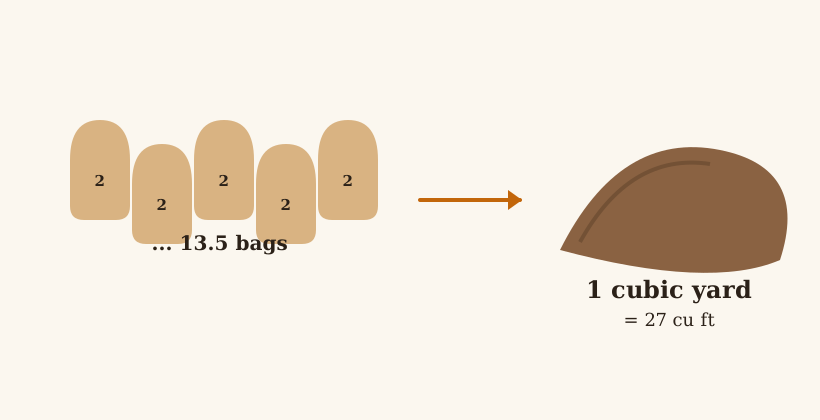
Retail and bulk are the same material measured two ways. One cubic yard is 27 cubic feet, which is 13.5 bags of 2 cu ft mulch, so a yard's worth bought by the bag is 14 bags. Going the other way, 25 bags of 2 cu ft is 50 cubic feet, which is 1.85 cubic yards. If the answer you need is in bags, divide cubic feet by the bag volume and round up; if it is in yards, divide cubic feet by 27 and round to whatever precision the supplier quotes in.
Three cu ft bags are the shortcut in this arithmetic: a cubic yard is exactly 9 of them, and 100 square feet at three inches is 12 of them, with a bag or so left over for the edges. If a supplier only quotes in yards and you only think in bags, remember 14 bags of 2 cu ft to the yard and you will never be far out.
Is the bigger bag actually cheaper?
Not automatically. The shelf price of a 3 cu ft bag is higher than a 2 cu ft bag, and the only fair comparison is price divided by cubic feet. Do that sum in the aisle: a bag at 2 cu ft for one price and a bag at 3 cu ft for another are rarely in the same proportion, and the difference over twenty bags is real money. The 1.5 cu ft bags are usually the worst value per cubic foot, and they exist because they are easy to lift rather than because they are economical.
Bulk is cheaper per cubic foot again, but only after the minimum order and the delivery charge are absorbed. Below about a cubic yard and a half, bags almost always win on total cost, even at retail prices, because you are paying for exactly the volume you need and nothing else. Above two or three cubic yards, the gap widens quickly in favour of loose material, and the calculation stops being close.
Handling: what the bag count really means
Twenty-five bags is not a volume problem, it is a lifting problem. Each bag has to come out of the shop, into the car, out of the car, along the path, and then be split and spread. That is four handlings per bag before the mulch is on the bed, and it is the reason a bulk tip near the beds feels like a luxury until the first time you use it. Buy the smallest number of the largest bags that gets you the volume you need, and stage the pile near the beds rather than at the front door.
Bagged mulch is sold by volume, not weight, so the weight varies with species, moisture and how tightly the bag was filled. Wet bags are heavier than dry ones, and a bag that has been sitting in the rain is heavier still. Load with that in mind, keep the weight low and forward in whatever you are driving, and make two trips rather than one if the car starts to sit down at the back.
Settling, and why the last bag never seems to be enough
Mulch is loose material and it settles. The layer you spread at three inches in spring compresses as rain packs it down and as the material works into the gaps in the layer underneath, so by midsummer it measures and looks thinner than the day it went on. That is normal behaviour, not a short delivery. It is also why the bed that only needed a top-up often needs more than the arithmetic suggests, particularly where the previous layer had weathered to a pale crust.
It is worth separating settling from decomposition, because the two get blamed for each other. Settling happens within weeks and is purely mechanical: the material packs down and the layer thins. Decomposition takes years and genuinely removes volume as bark breaks down into organic matter. In a newly mulched bed it is settling you are seeing, and a modest top-up is the right response; after the first season, an annual top-up replaces what the soil has digested.
Two practical consequences. Buy for the depth you want the bed to be after settling, not the depth that looks right mid-spread. And when the job is large enough that being short would be painful, add roughly one bag in ten for settlement, curves and the thin strips along edging, where coverage is worst and nobody measures carefully.
When the bed is not a rectangle
Curved borders, island beds and tree rings all defeat a simple length by width. Measure the longest and widest spans, then the narrowest, and average each pair; use those averages as the rectangle. For a circle, measure the distance across the mulch at its widest point, halve it for the radius, and use 3.14 × radius × radius for the area. For an L-shaped bed, split it into two rectangles, work each one, and add the square feet before converting.
Whatever the shape, do the conversion to bags last. Converting each section separately and rounding up at every step is how a garden ends up with four spare bags, a plant that needed that money, and a garage corner full of half-used mulch.
Where these figures come from
- Clemson University HGIC 1604, Mulch — one cubic yard covers 324 square feet at one inch of depth, which scales to 108 square feet at three inches and is consistent with every coverage figure in the table above.
- University of Maryland Extension, Mulching Trees and Shrubs — depth guidance by material type and the clearance that should be left between mulch and the trunk of a tree.
Coverage is calculated from bag volume and depth only: 2 cu ft divided by 0.25 ft of depth is 8 sq ft. Check the volume printed on the bag, since retail bag sizes vary between brands and regions.