Compost is a top dressing, not a mulch
Compost and mulch are both sold by the cubic yard and both get spread with the same fork, which is why the two get confused. They do different jobs. Mulch sits on top of the soil, two to four inches of it, to shade the surface, hold moisture and slow weeds. Compost is a feed and a soil amendment, spread much thinner: a quarter inch to an inch on a lawn, one to three inches worked into a bed. This calculator takes the length and width of the area and the depth you mean to spread, and returns cubic feet, cubic yards, the count of 40 lb bags at 0.75 cubic feet each, the count of 1 cubic foot bags, and the weight in tons at about half a ton per cubic yard.
Nothing rounds down. Bag counts round up, because a quarter of a bag left in the garage is cheaper than a second trip to the store. The estimate assumes a flat rectangle, which is what most gardens turn out to be once you stop measuring around every shrub.
The three lines of arithmetic behind every answer
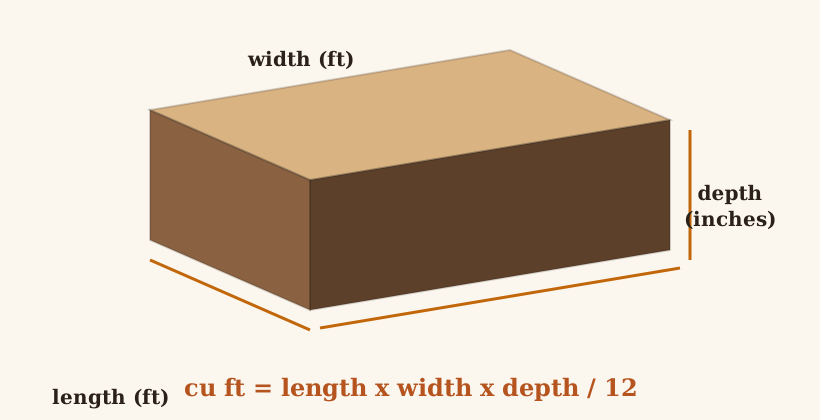
- Cubic feet = length in feet × width in feet × depth in inches ÷ 12
- Cubic yards = cubic feet ÷ 27
- Bags = cubic feet ÷ bag yield, then rounded up to a whole bag
- Tons = cubic yards × 0.5, the average weight of mature compost
That is the whole system, and every figure here is those four lines applied to a different patch of ground. The only judgement call is the depth, and on compost that depth is measured in fractions of an inch rather than the handfuls of inches mulch uses.
Worked example: a new 20 ft by 10 ft vegetable bed at 3 inches
Twenty feet by ten feet is 200 square feet, the most common size for a first-year vegetable plot. At three inches deep the arithmetic is 20 × 10 × 3 ÷ 12 = 50 cubic feet. Divide by 27 and the order is 1.85 cubic yards. A 40 lb bag holds 0.75 cubic feet, so 50 ÷ 0.75 = 66.67, which means 67 bags. At half a ton per cubic yard the material weighs about 0.93 tons.
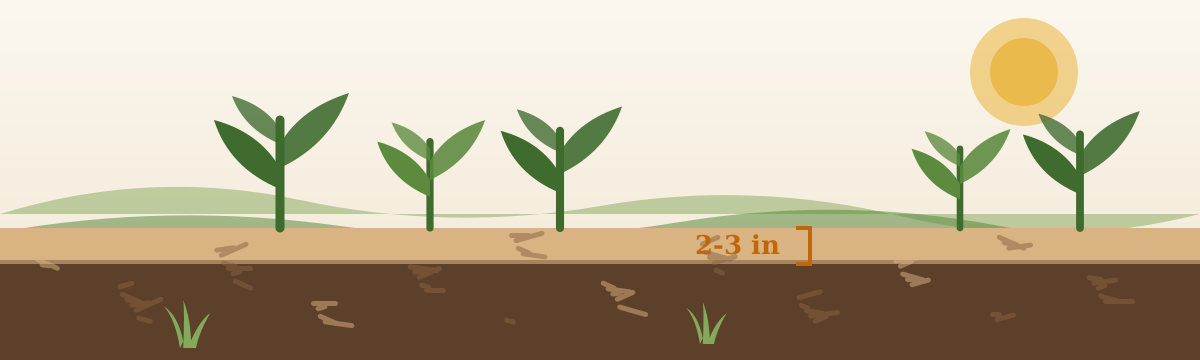
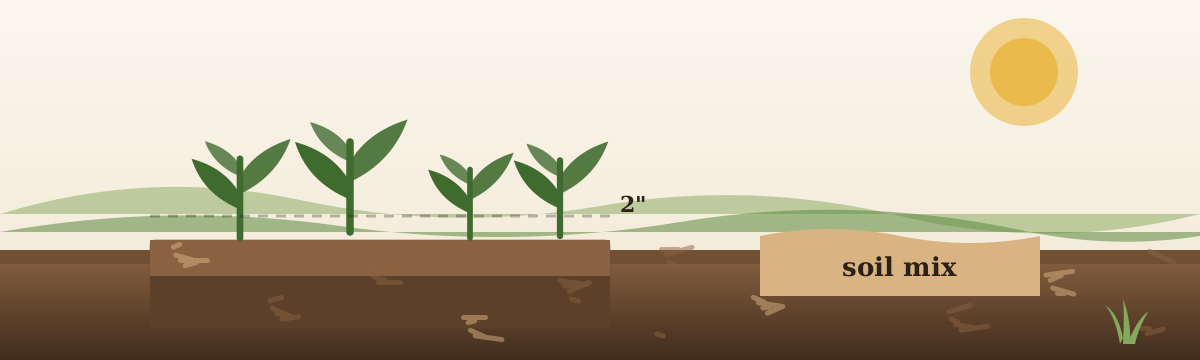
Three inches is the deep end of the compost range and it belongs to a bed being built rather than fed: the compost is mixed into the top six to eight inches of existing soil, not left sitting on top of it. If the bed already grows things and the plan is simply to feed it, use one inch and the same plot comes down to 16.67 cubic feet, 0.62 cubic yards, 23 bags and 0.31 tons.
Worked example: top dressing a lawn at a quarter inch
A 50 ft by 30 ft front lawn is 1,500 square feet. A quarter inch is the standard compost top dressing for an established lawn, thin enough that the blades push through it. The arithmetic is 50 × 30 × 0.25 ÷ 12 = 31.25 cubic feet, which is 1.16 cubic yards, 42 bags of 40 lb and 0.58 tons.
Two things go wrong here. The first is spreading it too thick: an eighth of an inch is plenty on a lawn already growing well, and past half an inch the compost smothers the crowns and leaves dead patches by midsummer. The second is doing it in high summer. Compost needs water to wash it into the root zone, so an autumn dressing does more than the same material spread in July.
Worked example: what one bag actually covers
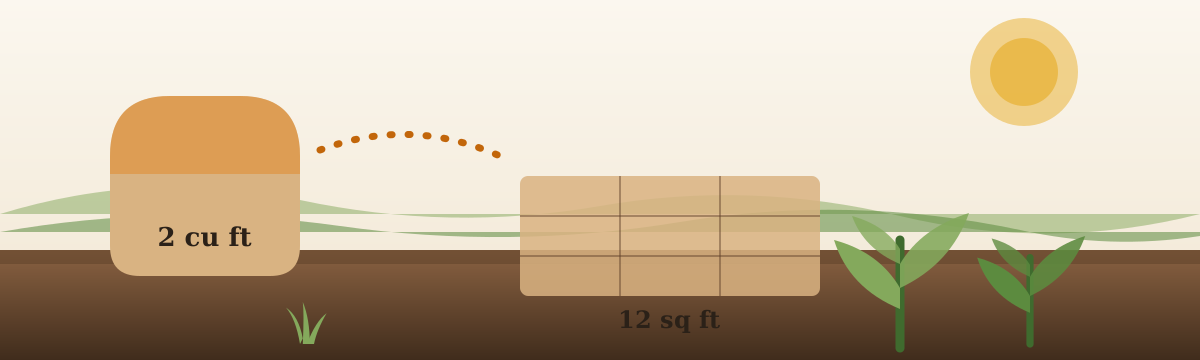
Retail bags hold 0.75 or 1 cubic foot, and the area they cover depends entirely on how thin you spread them. Coverage in square feet is cubic feet × 12 ÷ depth in inches. A 0.75 cubic foot bag therefore covers 9 square feet at one inch, 18 square feet at half an inch and 36 square feet at a quarter inch. A 1 cubic foot bag covers 12, 24 and 48 square feet at those same three depths.
- 0.75 cu ft bag — 9 sq ft at 1 in, 18 sq ft at ½ in, 36 sq ft at ¼ in
- 1 cu ft bag — 12 sq ft at 1 in, 24 sq ft at ½ in, 48 sq ft at ¼ in
- 1 cubic yard — 324 sq ft at 1 in, 648 sq ft at ½ in, 1,296 sq ft at ¼ in
- 1 cubic yard in bags — 36 bags of 0.75 cu ft, or exactly 27 bags of 1 cu ft
Compost or mulch? The depth number tells you which
If the depth you need is two to four inches, you are buying mulch. If it is a quarter inch to an inch on turf, or one to three inches worked into a bed, you are buying compost. That difference in depth is a factor of four to twelve in volume, which is why the wrong material in the wrong place either smothers a lawn or vanishes into the soil within a fortnight.
- Compost — a feed and soil conditioner, dark, crumbly, no recognisable pieces; ¼–1 in on turf, 1–3 in in beds, worked in rather than left on the surface
- Mulch — a surface blanket of bark, straw or wood chips; 2–4 in, topped up as it weathers, kept clear of trunks and stems
- Screened topsoil — mineral soil with some compost blended in, sold for filling, and far heavier per yard than compost
What a 30:1 carbon-to-nitrogen ratio actually means
The microbes that break down a compost heap need carbon for energy and nitrogen to build protein, and they work fastest at roughly thirty parts carbon to one part nitrogen by weight. Too much carbon and the heap stalls while the microbes borrow nitrogen from the soil underneath; too much nitrogen and the heap goes anaerobic, smells of ammonia and loses that nitrogen to the air. This is why composting instructions talk about browns and greens instead of ingredients: browns are the carbon, greens are the nitrogen, and roughly three parts brown to one part green by volume lands near 30:1.
- Browns, about 30–100:1 — dry leaves, straw, cardboard, wood chips, sawdust, shredded paper
- Greens, about 10–20:1 — grass clippings, kitchen scraps, coffee grounds, fresh trimmings, manure from animals that eat plants
- Finished compost, about 10–20:1 — the ratio has already been worked down by the heap, which is why mature compost can be spread straight onto a bed and raw material cannot
A 30:1 starting ratio is not the same thing as maturity, and the two get treated as synonyms. A heap can start at 30:1 and still be half finished six weeks later, and half finished compost is the material that damages plants. The ratio decides how fast the heap heats up. The curing time decides whether it is safe to spread.
Why unfinished compost burns roots
Compost that is still active keeps decomposing after it is spread. The microbes doing the work pull oxygen out of the surrounding soil, raise the temperature in the root zone, release ammonia and tie up available nitrogen as they multiply. Seedlings planted into two-week-old compost stall, yellow at the leaf tips and then scorch at the margins, and the damage gets blamed on the compost being too strong when the real problem is that it was still working.
Three tests settle it without a laboratory. Smell: finished compost smells of wet forest floor, where unfinished compost smells sour, of ammonia or of the original material. Temperature: a fistful sealed in a jar should not warm up noticeably within a day. Bioassay: sow four radish seeds in a cup of the compost and four in a cup of ordinary garden soil, and if the compost seedlings are slower, shorter or paler after ten days, turn the heap and give it another month.
How much does a cubic yard of compost weigh?
Mature compost runs about half a ton per cubic yard, roughly 1,000 lb, which is the figure behind the tons line. The number moves with moisture: a yard straight off a wet autumn windrow can pass 1,400 lb, while a dry screened product can sit nearer 800. That matters twice over. A half-ton pickup is rated for weight rather than volume, and two yards of wet compost will exceed it. Delivery is often quoted per ton rather than per yard.
The bag line and the ton line rest on different assumptions
The bag count assumes a 40 lb bag holds about 0.75 cubic feet. Thirty-six of those make a cubic yard, which works out at roughly 1,440 lb per yard, noticeably heavier than the half-ton average the tons line uses. The gap is real and neither convention is wrong: bagged compost is usually moister and screened finer than bulk product, so the same volume holds more weight. Treat the bags as what goes in the car, the tons as what the truck can carry, and the label as the tie-breaker.
Bags or bulk
By the bag, one cubic yard is 36 bags of 0.75 cubic feet, so the arithmetic is honest but the handling is not: 36 forty-pound bags is more than 1,400 lb moved by hand. Bulk wins once the order passes about a yard and a half, where the delivery charge stops dominating the total, and it wins outright for a lawn top dressing measured in cubic yards. Bags still make sense for a single bed, a patch repair, or a product you want to compare before committing to a truckload.
Where these numbers come from
- US EPA, Composting — what composting is, and why finished material is a soil amendment
- US EPA, Approaches to composting — the carbon-to-nitrogen balance, pile conditions and pathogen kill
- Clemson University HGIC, Composting — browns and greens, and the 30:1 target
- USDA NRCS, Soil health — what organic matter does for structure and nutrient cycling
The volume arithmetic is the same one used on every page of this site, and the depth guidance is the range those sources give for compost, not mulch. Figures were cross-checked against the calculator engine on 25 October 2026; the 0.75 cu ft bag yield and the half-ton-per-yard figure are conventional retail values, so check the label on the product you are buying.