Barrel size is decided by two multiplications, not a chart
Ask how big a rain barrel you need and most answers hand you a shopping list. The honest answer comes from two numbers about your own house: how much roof drains toward the barrel, and how much rain falls on it in one storm. Multiply those together and you know how many gallons arrive — everything after that is choosing which fraction of that water you want to keep.
The conversion is small enough to remember. Clemson Cooperative Extension puts it at 0.623 gallons per square foot of roof per inch of rain: multiply the roof area you are directing into the barrel by 0.623, and that is the water one inch of rain delivers. Purdue Extension's rainwater harvesting guide writes the same arithmetic as a formula — catchment area in square feet, times rainfall depth in inches, times 0.62, times 0.85 — where the last factor acknowledges that splashing, evaporation and first-flush diversion never let you keep everything. Purdue notes such losses can reduce the total volume by up to 15 percent.
What one inch of rain actually delivers
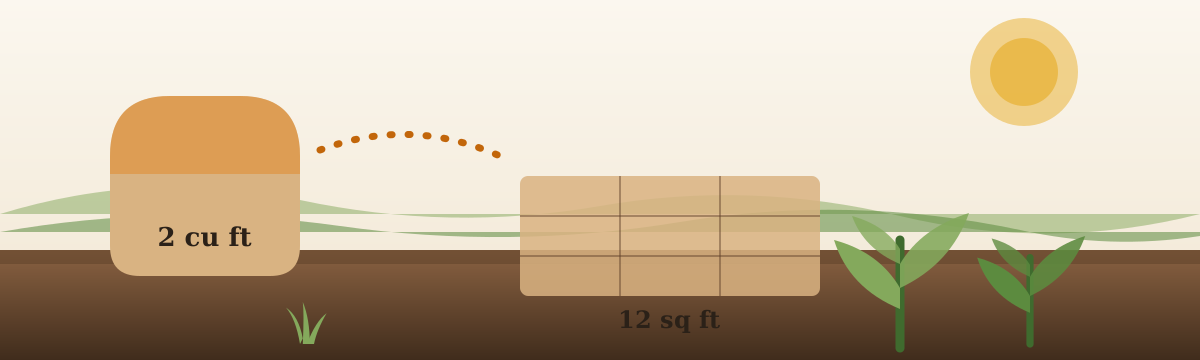
Take the standard example, a 1,000 square foot section of roof. One inch of rain on it produces 83.33 cubic feet of water — the same volume calculation our soil calculators do — which by Clemson's 0.623 factor is 623 gallons. University of Wisconsin Extension rounds the same figure to about 600 gallons per inch per 1,000 square feet, which is the useful mental shortcut: roughly a gallon per two square feet of roof, per inch of rain.
Half an inch, a common overnight rain, delivers 311.5 gallons gross on that same roof. Purdue's net figure, after the 15 percent allowance, is 263.5 gallons. Either way, the point stands: a typical storm brings several times more water than any barrel holds. The barrel is not a reservoir for the storm; it is a sampler of it.
Why a small slice of roof fills the barrel
This is the part that surprises people doing the math for the first time. Clemson notes that with a single rain barrel, as little as 100 square feet of roof surface may yield enough runoff to fill it quickly. Run the numbers: 100 square feet in a one-inch rain is 62.3 gallons gross — more than a 55-gallon barrel wants. On Purdue's net figure the same slice yields 52.7 gallons, right at the brim.
So a 55-gallon barrel does not need your whole roof. It needs one modest downspout's worth of it, and it fills in the first fraction of an inch of a real storm. Everything the rest of the storm sends down that downspout is overflow by design — which is why a diverter or an overflow hose pointing away from the foundation is part of the installation, not an accessory.
How big the barrel should be, given that
Sizing is a water budget, not a maximization problem. Purdue frames it exactly that way: the optimal size is approximated by estimating the water supplied by rainfall against the demand of whatever you are watering. A barrel that is always full and always overflowing is too big for its roof slice; a barrel that is empty the day after it rains is too small for the garden drawing on it.
In practice the common unit is small. Wisconsin describes reconditioned food-grade plastic barrels of approximately 55 to 60 gallons as the typical choice, and Purdue's guide spans rain barrels around 55 gallons up to cisterns from 50 to more than 1,000 gallons when the water budget justifies one. If your demand is a few raised beds through dry spells, the arithmetic above says one 55-gallon barrel per downspout captures the useful start of every storm and lets the rest go. Scaling up means linking barrels or moving to a cistern, and the sizing formula does not change.
Linking barrels is standard hardware, not improvisation. Wisconsin's build notes list valves for connecting multiple barrels together with hoses, and recommend adding spigots and hoses at the top of a barrel to link several and maximize collection — plus an overflow valve near the top that redirects water whenever everything is full. Clemson describes the same fitting from the house-protection side: an emergency overflow that lets water escape when the barrel is full and directs it away from the building foundation. Wisconsin also specifies a spigot a few inches from the bottom, which is what lets you drain the barrel completely — a job you will do every fall wherever winters freeze.
Two cautions the sources attach to the water itself
First, roof material matters before a drop is stored. Wisconsin advises against harvesting from tar and gravel roofs, asbestos, or treated cedar shakes; Purdue's list adds copper and untreated metal, which can leach zinc, treated wood, and anything with lead-based paint, while naming metal, plastic, clay tile and concrete tile as the cleanest surfaces. Asphalt shingles in good condition are suitable.
Second, barrel water is for ornamental watering, not the vegetable patch. Wisconsin states plainly that because roofing materials can shed bacteria and fungi, rain barrel water is not recommended for use on vegetables or for human consumption. That single restriction shapes the whole sizing question: the demand you are budgeting for is ornamental beds, containers and lawn spots, not the food garden.
Weight deserves its own warning. Clemson notes a 55-gallon rain barrel weighs over 450 pounds when full, and that elevated barrels must be secured properly. Wisconsin makes the same point from the child-safety side: several hundred pounds of water on a stand that tips is a real hazard. A full barrel is an immovable object; put it where it will never need to be moved and never lean a ladder against it.
How this page fits with the rest of this site
Every calculator on this site measures materials you carry and spread — soil, compost, mulch. This page measures something you never touch: the water your roof already delivers for free. The two meet at the bed. A barrel stretches the dry spells that the right mulch depth is designed to stretch, and the water you harvest mostly ends up on the same raised beds whose fill volume the raised bed soil calculator sizes. What none of these pages can do is tell you your local rainfall — that number comes from your own rain gauge or nearest weather record, and it is the one input the two formulas above cannot do without.
The formulas and the numbers behind them
| Figure | Value | Source |
|---|---|---|
| Gallons per sq ft of roof per inch of rain | 0.623 | Clemson Cooperative Extension |
| Full sizing formula | area × depth × 0.62 × 0.85 | Purdue Extension (WQ-40) |
| Losses from splashing, evaporation, first flush | up to 15% | Purdue Extension (WQ-40) |
| 1,000 sq ft roof, one inch of rain | about 600 gallons | University of Wisconsin Extension |
| Roof slice that fills one barrel quickly | as little as 100 sq ft | Clemson Cooperative Extension |
| Common barrel size | 55–60 gal, food-grade | University of Wisconsin Extension |
| Full 55-gal barrel weighs | over 450 lb | Clemson Cooperative Extension |
The worked examples were cross-checked on 29 October 2026: the cubic-foot volumes come from the same volume engine this site's calculators use, the gallon figures apply Clemson's 0.623 factor in a script, and the two independent conversion routes agree — 0.623 × 12 gives 7.476 gallons per cubic foot, while USGS's published rate of 1 million gallons per day = 1.547 cubic feet per second works out to 7.482 gallons per cubic foot. U.S. Geological Survey, A Million Gallons of Water.