Compost is a timing decision before it is a quantity decision
Every volume question in this section — how many bags fill a raised bed, how many yards cover a lawn — ends at a calculator. This page answers the question the calculators cannot: when to actually spread it. Compost timing is set by plant growth, not by the pile. A bin finishes on whatever schedule its materials, moisture and temperature allow, but the days you put compost on the ground are chosen around when grass and vegetables can use it — and, just as important, the stretches when they cannot.
Compost is forgiving, so wrong timing rarely kills anything. What it does is waste material and effort. A heavy dump on a lawn in July mostly sits there, scorches the grass beneath it, and does nothing the same material would not have done better in September. The guidance below is drawn from university extension services that publish their timing recommendations openly, and every depth or calendar claim on this page traces to one of the four sources cited.
The two windows: late spring and early fall
For established lawns and landscape beds, the extension services converge on the same two windows. Oregon State University Extension puts it directly for lawn topdressing: late spring and early fall are the best times of year for this work. Nebraska Extension in Lancaster County attaches a calendar to the same advice: apply a compost topdressing in September, or after the first spring mowing — and not during the middle of summer.
The reasoning behind the windows is ordinary plant physiology. In late spring and early fall, grass is growing strongly enough to recover from mowing, dethatching and aeration, and to grow up through a thin layer of compost within a few weeks. In midsummer, cool-season lawn grass is stressed by heat; burying it under even a thin layer at that moment adds stress instead of relieving it. In winter, the soil life that turns compost into plant-available nutrients is too cold to work quickly, and rain moves the material off target before it integrates.
Topdressing a lawn: the sequence and the layer
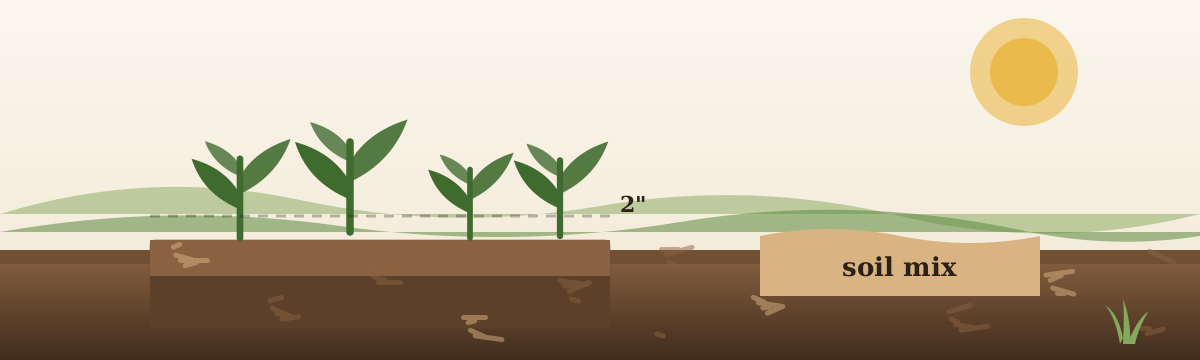
Oregon State describes the sequence for an existing lawn: mow short and collect the clippings, dethatch or rake to expose some soil, run a core aerator over the area, then spread compost one-quarter to one-half inch deep. The compost settles into the aeration holes. Nebraska gives the seasonal slot for that same job: September, or right after the first mow of spring.
If you are overseeding at the same time, Oregon State notes you can spread seed before or after applying the compost, and that new seed sprouts quickly once soil temperature is above 60 degrees Fahrenheit — one more reason the work belongs in the spring and fall windows rather than summer.
There is also the question of what the layer is buying you. Nebraska's description of topdressing lists the returns: improved soil structure, added organic matter and nutrients, and faster decomposition of thatch. None of those arrive from a single application — they are cumulative, which is why the extension guidance treats topdressing as a repeatable seasonal habit rather than a cure applied once.
What those depths mean in material: take a lawn 25 feet by 20 feet — 500 square feet — and give it the deeper half-inch layer. That is 20.83 cubic feet of compost, or 0.77 cubic yards, which is roughly 21 of the one-cubic-foot bags garden centres sell. The same lawn at a quarter inch takes about half of that. Neither figure includes any allowance for settling; the compost packs into aeration holes and thins as it breaks into the turf, which is why topdressing is a repeat job rather than a one-time fix.
Vegetable beds: one deep pass, then shallow annual top-ups
Vegetable beds follow a different rhythm. Oregon State recommends 3 to 4 inches of compost worked into the top 8 to 12 inches of soil for a new vegetable bed, and one-quarter to 1 inch per year for an established one. Nebraska Extension adds the scheduling anchor: soils benefit from being amended before planting, which is what makes the fall and early-spring windows useful for bed work too — the material is in the ground and partly settled before seeds or transplants arrive.
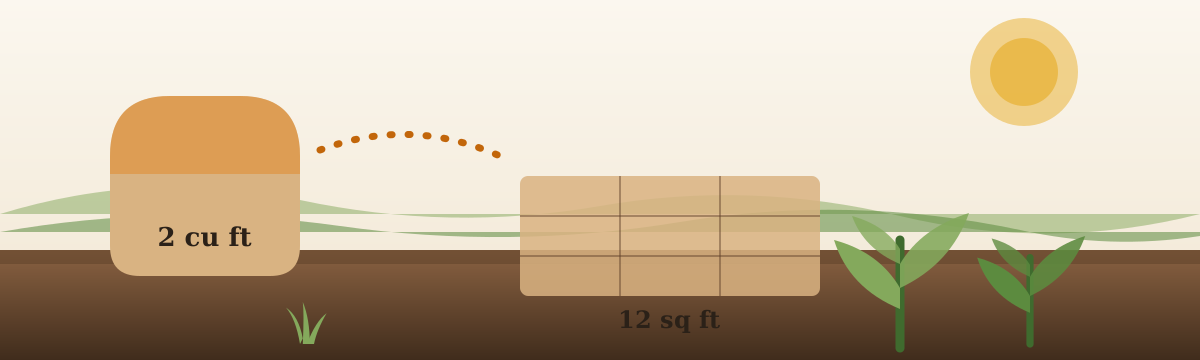
A new bed shows how large that first pass is. Take the classic 4 foot by 8 foot raised bed and work 3 inches of compost into it: that is 8 cubic feet, or 0.3 cubic yards — about 8 one-cubic-foot bags, gone in a single morning for a bed you could stand in. It is the largest single compost purchase most gardens ever make.
The yearly maintenance pass is much smaller. The same 4 by 8 bed at the 1-inch annual rate is 2.67 cubic feet, or 0.1 cubic yards — about 3 bags. That gap between the first year and every year after is the whole shape of compost budgeting: one deep incorporation, then thin repeated layers that feed the surface. Spreading the annual dose as two half-inch passes, one at each end of the season, fits the two windows above and keeps the surface open.
When compost hurts instead of helps
The depth ranges above are ceilings, not targets to beat. Oregon State warns that when too much compost is added, plants growing in the amended area fail to thrive — smothered turf, waterlogged surface layers, and nutrient imbalances all arrive together. Nebraska cites research finding decreased plant growth in potting mixes made up of more than 50 percent compost. And the limit is not only about quantity: University of Wisconsin Extension advises not adding compost at all when planting a tree — backfill with the original soil removed from the hole, because amended backfill can restrict root growth.
Summer belongs on this list too. Nebraska's "not during the middle of summer" is a timing rule, not a rate rule: the same compost that helps a lawn in September actively works against it in July. If a pile is finished midsummer, hold the material until the fall window opens. Finished compost keeps; a stressed lawn does not get the season back.
The timing, in one table
| Job | Window | Depth | Source |
|---|---|---|---|
| Topdressing an existing lawn | September, or after the first spring mowing | 1/4–1/2 in | Nebraska Ext. (calendar); Oregon State Ext. (depth) |
| New vegetable bed | Before planting — fall or early spring | 3–4 in, worked into the top 8–12 in | Oregon State Ext. (depth); Nebraska Ext. (before planting) |
| Established vegetable bed | Annually, before planting | 1/4–1 in per year | Oregon State Ext. |
| Tree planting | — | No compost in the backfill | Wisconsin Ext. |
One absence is worth noticing: midsummer appears on no row. It is the only season the sources exclude outright, and the easiest one to get wrong.
The bag, cubic-foot and cubic-yard figures in the three examples above were cross-checked against the live volume engine used by this site's calculators on 27 October 2026.
How this page fits with the rest of this site
This is deliberately a calendar-and-depth page, not a quantity page. Once you have picked a window from here and a depth from the ranges above, the compost calculator turns any area and depth into bags, cubic yards and tons. The two pages divide the same job: this one says when and how thick; that one says how many bags to put in the car.
The same division separates compost from mulch. Compost is worked into or onto soil as a food source; mulch is a wood or bark covering whose job is shading soil and blocking weeds, and it lives by different depth rules — that logic, and why a mulch layer is measured in inches rather than fractions of one, is on our mulch depth guide. If your question is how much soil a raised bed holds in total rather than how to feed one, the raised bed soil calculator handles that volume.